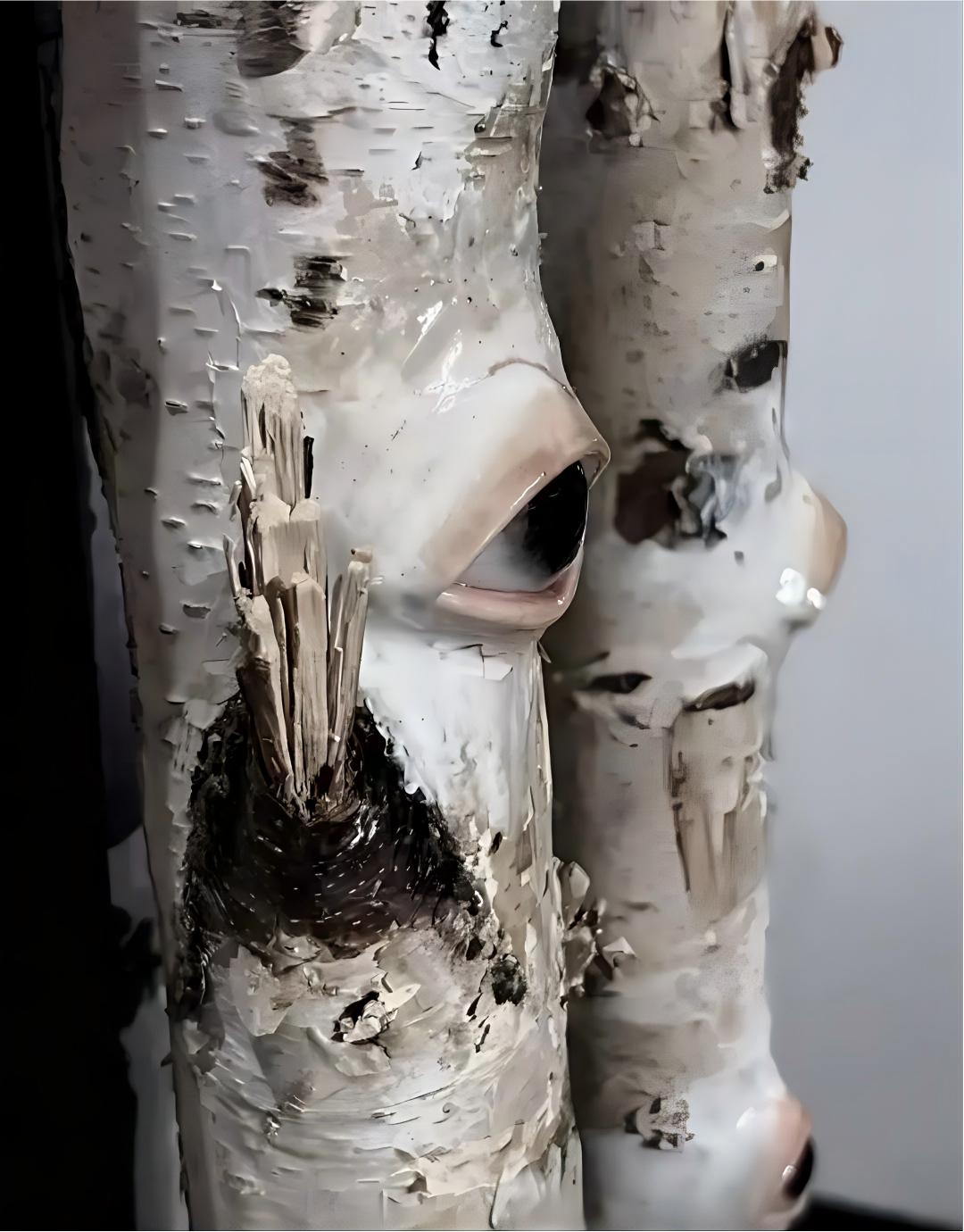
Every eye on a birch tree is a medal the tree awarded itself. Not for endurance. For transformation.

Excavation Background
When the storm snaps a branch, when the axe leaves its mark, the birch does not close the wound. It grows around it.
At the point of rupture, the tree generates supplementary tissue — a sphere of new growth that pushes outward against the bark, splitting the surface into a layered, lip-shaped aperture. What begins as damage ends as an eye. An organ that was never designed to see, and cannot stop looking.
Botanists call this formation a lenticel: the gateway through which the trunk exchanges breath with the open sky. The birch breathes through its wounds. It has always breathed through its wounds.
The works of 犬喜(Inuki) and 尤里_yoori(Yoori) begin here — at the point where damage becomes form, where rupture becomes record.
View Catalog Entry — Crime & Punishment Archive

Anatomical & Material Observation
Look into the pupil of a birch eye and you will find concentric rings — the annual record of a branch that no longer exists. Each ring is a year. Each year is a season of pressure, of frost, of the particular weight of snow on wood that has already been compromised.
The black pupil at the center is slightly convex. It carries fifty years of weather in its surface. It does not flatten under observation. It holds its shape the way memory holds its shape — compressed, dense, resistant to revision.
In spring, sap rises through the wound. It runs from the corner of the eye socket down the length of the bark. Farmers who have worked birch forests for generations call this liquid “lover’s tears.” They cup their hands beneath the v-shaped wound at the base of each eye and catch the sap as it falls — clear, faintly sweet, carrying the temperature of the interior of the tree.
The birch does not weep because it is in pain. It weeps because it is alive. The distinction matters.
Secure the Artifact — The Weeping Conch

Anomalous Properties
The birch eye is a dark art nature sculpture produced without human intervention — and without human permission. The tree does not ask whether the wound is aesthetically appropriate before it begins to heal. It simply heals, and the healing is beautiful in the way that biological necessity is always beautiful: completely, without self-consciousness, without awareness of being observed.
This is the quality that 犬喜(Inuki)and 尤里_yoori(Yoori)have identified and extended into their sculptural practice. The eye that forms at the point of rupture. The tear that runs from the wound in spring. The concentric rings that record what was lost. These are not metaphors in her work. They are materials.
For those assembling a wunderkammer or dark academia collection, the birch eye occupies a specific position in the history of natural specimens — one that predates the collector, predates the gallery, predates the archive. The tree was making these objects long before anyone thought to keep them.
Access Containment Logs — Full Archive

Archival Value
The birch tree does not grieve its wounds. It converts them. Every rupture becomes a gateway. Every scar becomes an eye. Every lost branch becomes a ring inside a pupil that will outlast the branch, outlast the season, outlast the farmer who cupped his hands beneath the wound and caught what fell.
Those drawn to macabre aesthetics and occult ritual objects will recognize the logic of this transformation. Those operating within the cabinet of curiosities and lovecraftian decor tradition will understand what it means to collect an object that was made by damage — and is more complete for it.
The archive is open. The specimens are available.
Share:
Conch Shell Eye Sculpture: The Clock That Opens Instead of Ticking