A clock does not have to tick to mark time. It only has to show you where you are in the process of becoming.

The Arrangement
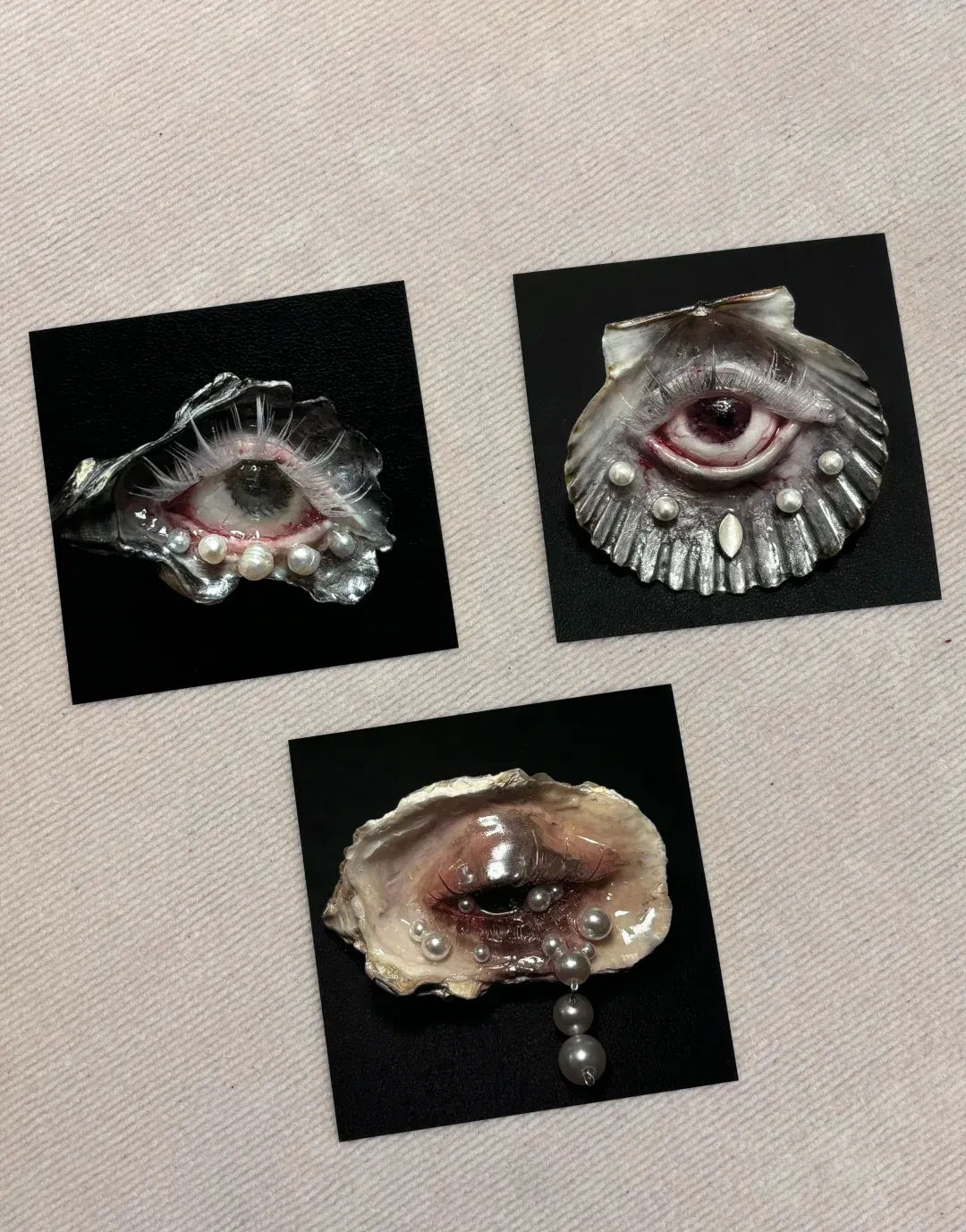
Conch shells arranged in a circle on a surface the color of dried earth. Inside each shell: an eye. At the center: a metal hand, pointing.
This is a clock. Not a timepiece. An instrument for marking where you are in a process that has no clear beginning and no clear end.
The process being marked is opening. Each shell is at a different stage — the first barely parted, the last fully open, the eye exposed and catching light. Between them: the increments that clocks usually skip over.
View Catalog Entry — Crime & Punishment Archive

Material Logic
The conch shell is already a record of time — each layer deposited incrementally, the surface growing outward as conditions allowed. To open it is to interrupt that record. To place an eye inside is to give the interruption a direction: outward, toward the light.
The most closed specimen shows only the edge of an iris. The most open shows the full surface of the eye — grey-blue, the pupil contracted, the surface carrying the wetness of something that has just become visible.
The metal hand at the center does not move. It points to one specimen and holds. That is the time. That is where the clock is waiting.
Secure the Artifact — The Weeping Conch

What the Clock Records
The eye does not open all at once. It opens the way a wound heals — from the inside out, without a single moment that can be identified as the moment of opening. By the time you notice it is open, it has been open for some time already.
Looking at this arrangement long enough produces a specific effect: the specimens that appeared closed begin to appear open. The clock does not tell you what time it is. It tells you that you have been looking long enough to change what you see.
Access Containment Logs — Full Archive

Share:
Birch Tree Eye Sculpture: Field Notes on a Wunderkammer Relic
Field Record: The Wounded Pierrot — Grotesque Troupe Effigies Act I