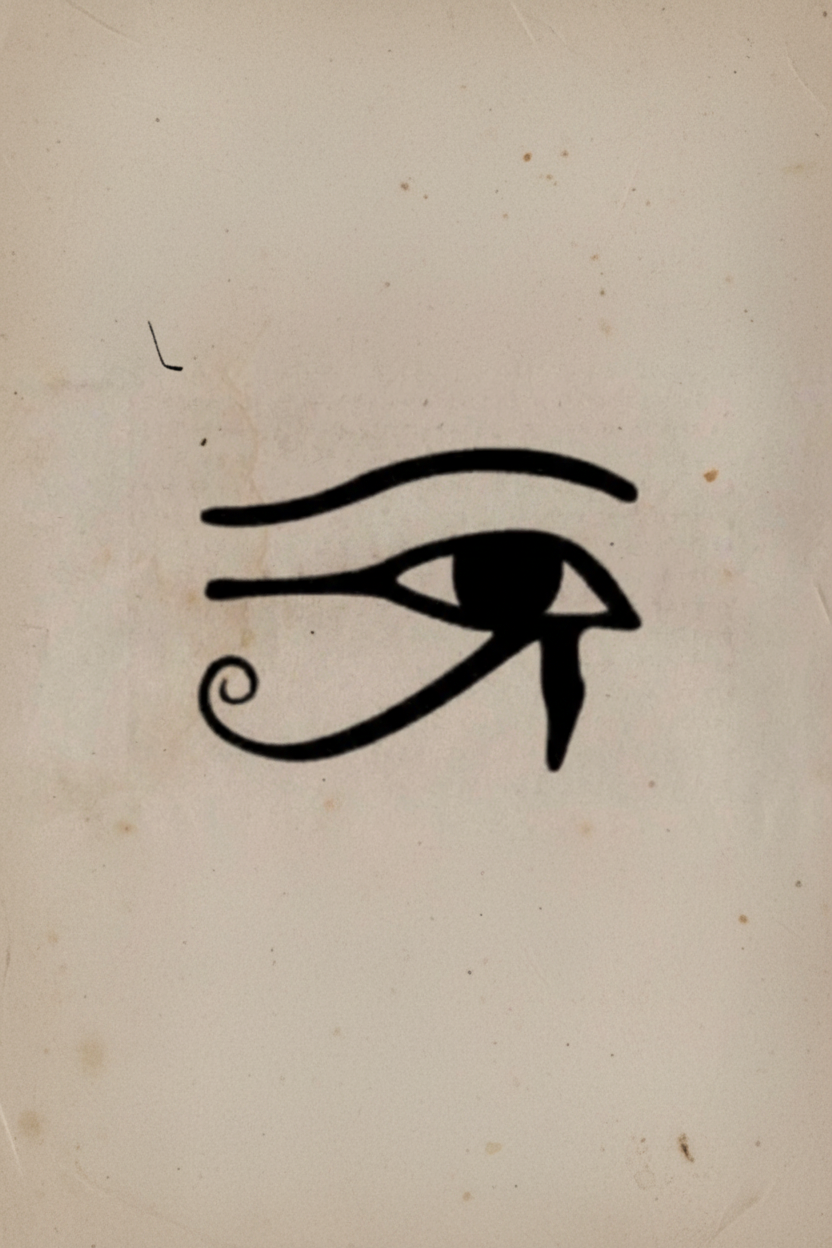
The Eye of Horus is one of the oldest magical symbols in recorded history. It carries healing and protection — a ward against harm that may come to you or those you love. But to understand what it actually is, you have to understand what it's made of.
 Two Eyes, Two Forces
Horus is an ancient sky god. And like the sky itself, he has two eyes.
The Right Eye — Eye of Ra
The right eye represents the sun. It carries masculine energy — the force that drives inquiry, logic, and causality. It is a symbol of good fortune and creative power. Where the right eye looks, things are made.
The Left Eye — Eye of Thoth
The left eye represents the moon. It carries feminine force — the power that turns inward, toward human nature and emotional depth. It is the eye of intuition and perception. Where the left eye looks, things are felt.
Together, they don't cancel each other out. They complete a circuit.
 The Six Parts of the Symbol
The Eye of Horus is not a single mark. It is a system — divided into six distinct parts, each one a fraction of the whole, each one mapped to a specific human sense.
The six parts divide the symbol into sixty-four equal portions in total. Each part corresponds to one of the six senses:
Smell. The part that reads the invisible — what the air carries before anything arrives.
Sight. The part that faces outward, registering what exists in the world.
Thought. The part that processes, interprets, and constructs meaning from what is received.
Hearing. The part attuned to vibration — what moves through space and reaches you.
Taste. The part that makes contact, that requires proximity to know.
Touch. The part that cannot lie — the most immediate, the most certain.
Six senses. Six fractions. One eye.
The symbol is not decorative. It is a map of how a living thing receives the world.
 The Eye and the Ankh
The Eye of Horus is most powerful when paired with the Ankh — the Key of Life.
The Ankh is the oldest symbol of immortality in the Egyptian canon. When combined with the Eye of Horus, the two symbols form a single statement:
To be seen by the Eye is to be protected. To carry the Ankh is to persist beyond the moment of protection.
Together, they represent shelter, the immortality of life, and the continuity of existence beyond harm. Not just survival — permanence.
The Eye watches. The Ankh holds.
That combination has been worn, carved, and buried with the dead for over three thousand years. It is not a trend. It is a record — of what human beings have always wanted when they reach for something beyond themselves.
To be seen. To be kept. To last.
Share:
The Aquarium Mythos: A Cthulhu Cosmology in Forty Gallons
A Modern Art Timeline Every Art Lover Should Know